Unknown Facts About the Indianapolis 500 - Page 2
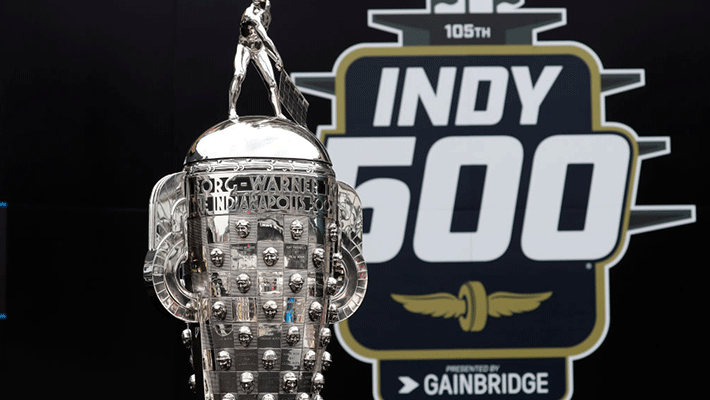
The magic of the Indy 500 runs deeper than its biggest headlines. Behind the famous traditions and iconic finishes is a world of stories that often gets overlooked.
Share the post
Share this link via
Or copy link

Unknown Facts About the Indianapolis 500
The Indianapolis 500 is more than a race.
It is one of America’s great sporting rituals, a place where speed, nerve, and history meet on the same stretch of asphalt every Memorial Day weekend.
For more than a century, the roar of engines at Indianapolis Motor Speedway has drawn generations of fans who know the winner’s milk, the packed grandstands, and the drama of 500 relentless miles.
But the magic of the Indy 500 runs deeper than its biggest headlines.
Behind the famous traditions and iconic finishes is a world of stories that often gets overlooked.
Some live in the bricks beneath the cars.
Some are tied to strange records, forgotten firsts, and moments that changed racing forever.
Others reveal how this event grew from a daring contest of endurance into a cultural landmark with its own language, customs, and legends.
That is what makes the Indianapolis 500 so compelling.
Even if you have watched it for years, there is always something new to uncover.
The race carries layers of history that reward a closer look, from odd traditions and near-mythic moments to details that help explain why this event still holds such a powerful place in American sports.
The more you dig into the Indy 500, the more fascinating it becomes.
Tale a look below at some Unknown Facts About the Indianapolis 500:
RELATED | Signs of the Indy 500 Start Appearing Downtown
RELATED | The Indy 500 Audio Guaranteed to Give You Chills
1. Balloon Races Before Cars
The very first event held at the Indianapolis Motor Speedway in 1909 wasn’t a car race at all. It was a helium gas-filled balloon competition!
2. The Original Track Wasn’t Brick
While it’s known as the “Brickyard,” the original 1909 track was made of crushed stone and tar, which proved dangerous. Over 3 million bricks were laid in 1911 to improve safety, creating the iconic surface. Only a symbolic yard of bricks at the start/finish line remains exposed today.
Love Mix 100.9 | 99.3? Get more! Join the Mix 100.9 | 99.3 Newsletter
We care about your data. See our privacy policy.
3. Milk Tradition’s Accidental Start
The famous tradition of the winner drinking milk began when Louis Meyer requested buttermilk after his 1936 victory, simply because his mother told him it was refreshing on a hot day. A photographer captured it, and dairy associations quickly capitalized on the marketing.
4. Champagne Before Milk:
In 1913, French driver Jules Goux reportedly drank four bottles of champagne during pit stops on his way to victory. This led to a “no drinking while driving” rule being established in 1914.
5. No Peanuts Allowed
A widespread superstition among drivers and teams considers peanuts to be bad luck at the Indy 500, stemming from incidents in the 1930s and 1940s where peanut shells were found in crashed cars or littered the track.
6. The “Riding Mechanic” Era
In the early days, most Indy 500 cars had two seats to accommodate a driver and an onboard “riding mechanic.” These mechanics were crucial for monitoring the car and advising the driver. This practice was mandatory from 1912-1923 and briefly returned in the 1930s.
7. “Carburation Day” Endures
Despite modern fuel injection systems replacing carburetors decades ago, the final practice session before the race is still known as “Carburation Day.” This name is a nod to an earlier era when teams would fine-tune their carburetors.
8. Pace Car Crash at the Start
In 1971, a local car dealer driving the Dodge Challenger pace car crashed into a photo stand at the start of the race, injuring 29 people.
9. Winners Who Didn’t Lead a Lap
In both 1924 and 1941, the winning cars had drivers replaced mid-race, and neither the starting driver nor the relief driver led a lap in their respective winning years. Their faces are still on the Borg-Warner Trophy!
Unknown Facts About the Indianapolis 500 - Page 2 was originally published on b1057.com